
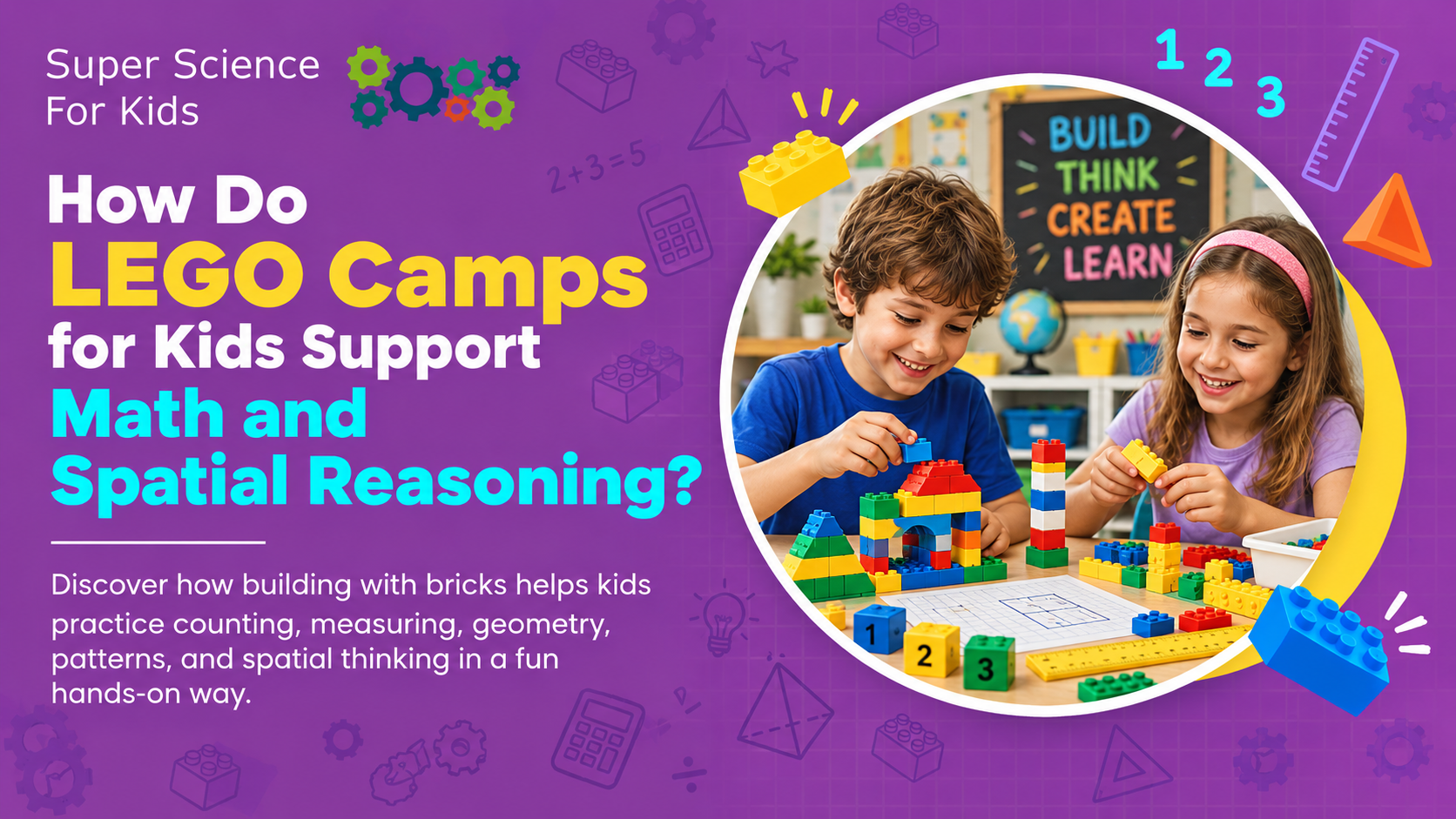
Building with LEGO bricks, children count, measure, and mentally turn shapes, giving them daily practice that helps build math and spatial reasoning skills. Super Science For Kids offers hands-on LEGO camps for kids that help children learn new things, work with other kids, and build a strong STEM foundation. That’s good news for any parent who wants to learn to play.
Table of Contents
- What Is Spatial Reasoning and Why Does It Matter for Kids?
- How Do LEGO Bricks Help Kids Practice Counting, Measuring, and Basic Math?
- How Do LEGO Camps Build Geometry and Shape Skills?
- How Do Instructors Turn Building Challenges Into Math Practice at LEGO Camp?
- How Does Spatial Skill From LEGO Camp Carry Over to School Math?
What Is Spatial Reasoning and Why Does It Matter for Kids?
Spatial reasoning means picturing a shape in your head and working out how it turns or fits with other shapes. Kids do it all day. They do it when they read a map, when they squeeze a lunchbox into a full backpack, when they guess whether the couch will get through the door.
It matters in school too. Fractions, graphs, and geometry all ask a child to see something in space, and kids who are comfortable with that usually find those topics less confusing. At Super Science For Kids, our LEGO camps let children practice it with their hands. A tower that leans gets rebuilt until it stands.
How Do LEGO Bricks Help Kids Practice Counting, Measuring, and Basic Math?
Every LEGO brick gives children something to tally, compare, and split into equal parts, so number skills build up naturally during play. Checking how many bumps a piece has, lining up two LEGOs side by side, and matching sizes all happen without a single worksheet. At Super Science For Kids, we guide children through LEGO building activities that turn this kind of play into steady skill-building. Here is what that looks like in action:
- Counting: Every LEGO brick has a set number of bumps: eight on a 2×4, six on a 2×3. A child who counts them to find the right piece is using numbers to describe something real that they can hold.
- Measuring: Measuring just means comparing size. When one tower stands taller than another, or a bridge falls short of the gap, the child sees what “taller” and “too short” mean without a ruler.
- Fractions: A half is one of two equal parts. Set two 2×2 bricks end to end and they match a 2×4 exactly, so each 2×2 is half of the long brick.
- Patterns: A pattern is anything that repeats in a set order. A wall built red, red, blue, red, red, blue shows it, and the child can tell what color comes next.
Check Out: Can LEGO Activities Help Kids with Anxiety? What Parents Should Know
How Do LEGO Camps Build Geometry and Shape Skills?
LEGO camps help children build geometry and shape skills by letting them hold shapes instead of just looking at them on a page. At Super Science For Kids, our campers build with real LEGO bricks, so they feel how angles meet, how sides line up, and why a model stands or falls.
When a roof won’t sit flat, they know something is off and fix it by turning the piece and trying again. Because they’ve already worked the shapes out with their hands, geometry makes more sense when it shows up in school. That is also how LEGO camps improve spatial reasoning in children: they keep turning, matching, and fitting real shapes until it comes naturally.
How Do Instructors Turn Building Challenges Into Math Practice at LEGO Camp?
LEGO camp instructors turn a building challenge into math practice by telling kids what to aim for, not how to get there. At Super Science For Kids, we set the goal and step back while campers measure, guess, test, and adjust until their build works. With a goal and no set steps, kids have to estimate, count, and check their own work.
How Does Spatial Skill From LEGO Camp Carry Over to School Math?
Structured LEGO building carries over to school math because it exercises three skills math relies on: mentally rotating a shape, holding an image in mind while working with it, and seeing how a whole is made of smaller parts. At Super Science For Kids, our camps give children a chance to practice all three. Those same skills come back when a child faces a diagram, a fraction, or a word problem in class.
Sign Your Child Up for LEGO Camp
Math does not have to live on worksheets. Building with bricks and taking on a friendly challenge can teach children things drills often miss. That is the quiet strength of LEGO camps that build math skills for kids: the learning sneaks in while children are busy having fun. Contact Super Science For Kids to register your child for our LEGO camp. We will help turn playtime into math confidence!
Stay tuned for our next blog, where we look at how a science summer camp can make school math feel easier.
Frequently Asked Questions
- Does a child need building experience to join a LEGO camp?
No. Beginners are welcome at Super Science For Kids, and we teach new skills as children build, so your child can learn at a comfortable pace. - How long does a LEGO camp usually last?
At Super Science For Kids, our LEGO camps usually run for about a week, with several hours of building each day. We also offer summer science programs to fill out your child’s summer. - Is LEGO camp only for kids who already love building?
No. Children who enjoy puzzles, stories, or design often love it too, and our camps blend building with STEM learning so different interests all fit.

Leave a Reply